
Summary: What is sprint reporting really accomplishing inside an Agile organization, and why would it matter to both project managers and business leaders?
Recently, we sat down with Russell Parker, a project manager specializing in risk management, and broke down sprint reporting beyond theory and into real-world application. From defining sprint reporting in practical terms to communicating results to non-Agile executives, Russell shares how reporting serves as a bridge between technical teams and business stakeholders.
What is a Sprint?
In Agile project management a sprint is an agreed upon amount of time between an agile project management team and a stakeholder. The team agrees on a specific amount of time (typically 2-4wks) in which an agreed-upon set of development tasks take place in their sprint.
Sprint reporting communicates sprint performance, delivery outcomes, risks, and forward-looking insights.
However, sprint reporting isn’t just about tracking velocity or backlog progress. It’s about:
- Translating Agile delivery into business outcomes
- Managing expectations across sprint cycles
- Communicating progress to non-technical stakeholders
How to Communicate Sprint Reports
Executives prefer simple charts that are easier to understand. Don’t we all.
While Agile teams may track velocity and detailed metrics internally, for leadership:
- Burndown charts are often the most effective
- Simplicity wins
- Context ends up mattering more than technical depth
Russ explains it plainly:
“We have 100 things to do… this is the perfect line to get there. This is where we’re at. If it’s below this line, I’m going to give you an explanation on why.”
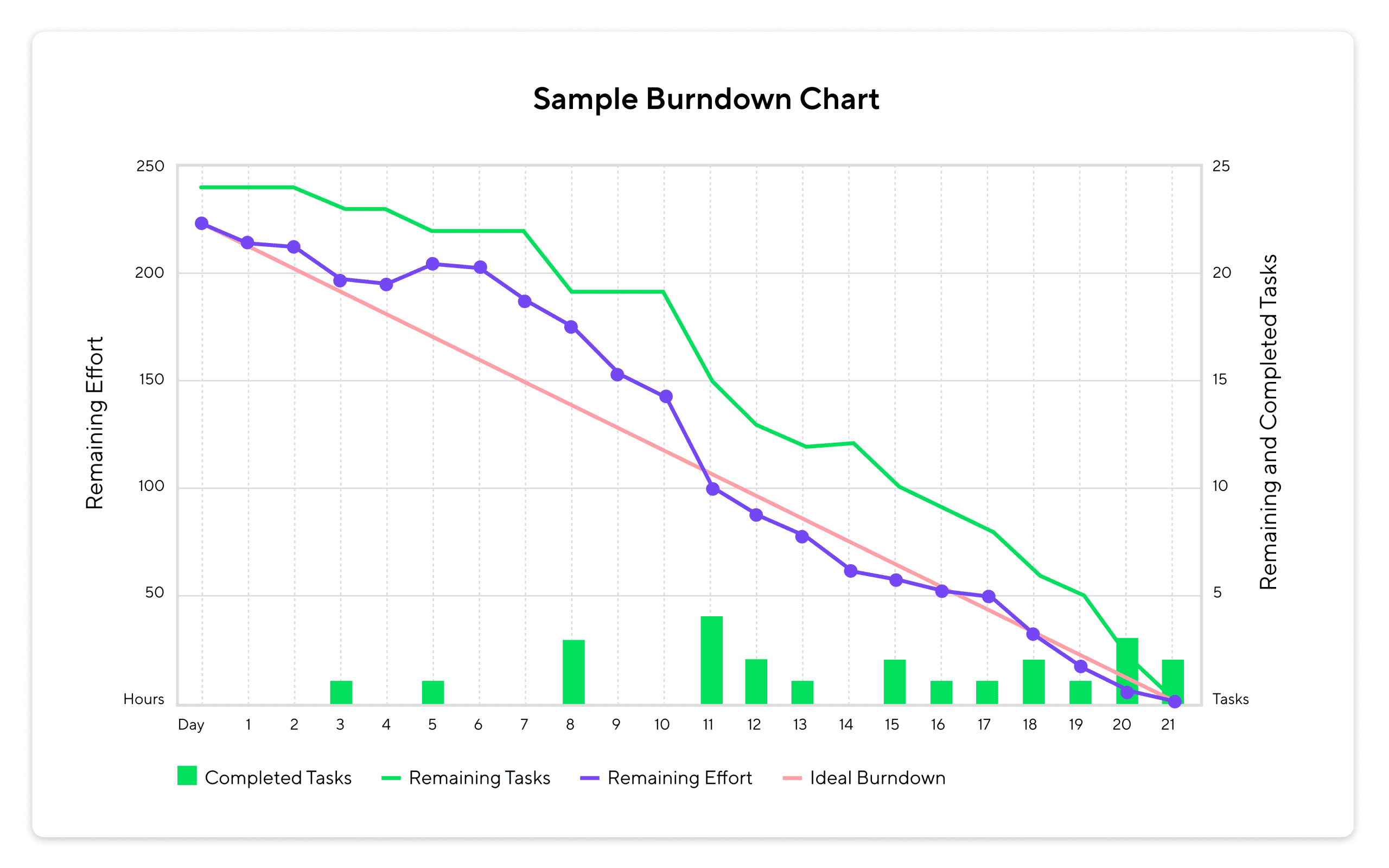
Effective communication with executives isn’t just about sharing reports; it’s about explaining them.
The Sprint Reporting Process
Sprint reporting isn’t only about getting to the end. Once a sprint has started, a mid-sprint check-in is needed to ensure the project is moving in the preferred direction.
What does the sprint check-in process look like?
Mid-Sprint:
- Higher-level summary
- General sprint health
- Coordination updates
- Early risk visibility
End of Sprint:
- Highly detailed report
- Completed work clearly outlined
- Clear status communicated
If a sprint spans 4 weeks, the middle week lets you preemptively report any problems you foresee. That preemptive communication is where sprint reporting becomes risk management.
What happens when a Sprint Goes off track?
Agile provides flexibility, but not unalignment.
Russ shared a recent example where, at the end of his team’s sprint, QA failed. Initially, he prepared to report an amber status. But hours later, the bug was found, everything was on schedule, and everything was back on track.
He had to adjust reporting in real-time.
That responsiveness highlights two things:
- Sprint reporting must reflect the current reality.
- Agile requires adaptability — without disrupting team focus.
Stakeholder Boundaries:
Boundaries with stakeholders must also be set in order to protect performance.
If a stakeholder requests a change during a sprint, it is important that their needs be addressed outside the sprint reporting process.
What separates a “good” report from a “great” one?
Naturally, it’s dependent on the project. A great sprint report + project manager is stakeholder-aware.
Russ emphasizes foundational project management principles before initiating a project:
- Stakeholder analysis
- Engagement matrices
- Communication planning
Even in Agile, it is crucial to plan accordingly.
In larger organizations, you cannot tailor 15 separate reports. But you can:
- Understand stakeholder preferences
- Find the middle ground
- Communicate consistently
- Address issues directly when necessary
A great report doesn’t debate.
It updates.
It informs.
It clarifies.
As an Aspiring Project Manager, what should I know about Sprint Reports?
Aspiring or current project managers should gain a foundational understanding of sprint reporting and avoid being swept up in rigid templates.
Sprint reporting is:
- Situational
- Stakeholder-dependent
- Context driven
Coming into Agile project management, learn how to read reports, how to communicate them, and do situational analysis simulations to better understand how to coordinate different scenarios.
PMI has a Sprint Simulation Game built for this practice.
Why Sprint Reporting Matters
What can sprint reporting provide for your organization?
- Predictable delivery visibility
- Reduced mid-project surprises
- Clear risk escalation paths
- Executive-friendly communication
- Protected team focus
Strong sprint reporting doesn’t just track work; it builds trust, prevents chaos, and aligns delivery with strategy.
And in Agile environments, that alignment is everything.

Russell Parker
ATP Instructor- PMP & PMI-RMP
Russell Parker (he/him/his) helps project managers and risk professionals become proactive over reactive—so they can anticipate risks, make smarter decisions, and lead with confidence. With 20+ years of experience, including his time as a U.S. Marine Corps officer and corporate project manager, He’s seen what separates struggling project managers from those who thrive. It’s not just knowledge—it’s the ability to think ahead, manage risk, and lead under pressure. Through training, coaching, and strategic mentorship, he equip PMs with the risk mindset, leadership skills, and proven frameworks they need to consistently deliver successful projects.
He is also the owner of Forty-Four Risk PM, LLC, which has been reviewed and approved by the PMI® Authorized Training Partner Program.