
 (802) 372-1377
 info@tuckconsultinggroup.com
 Tuck Consulting Group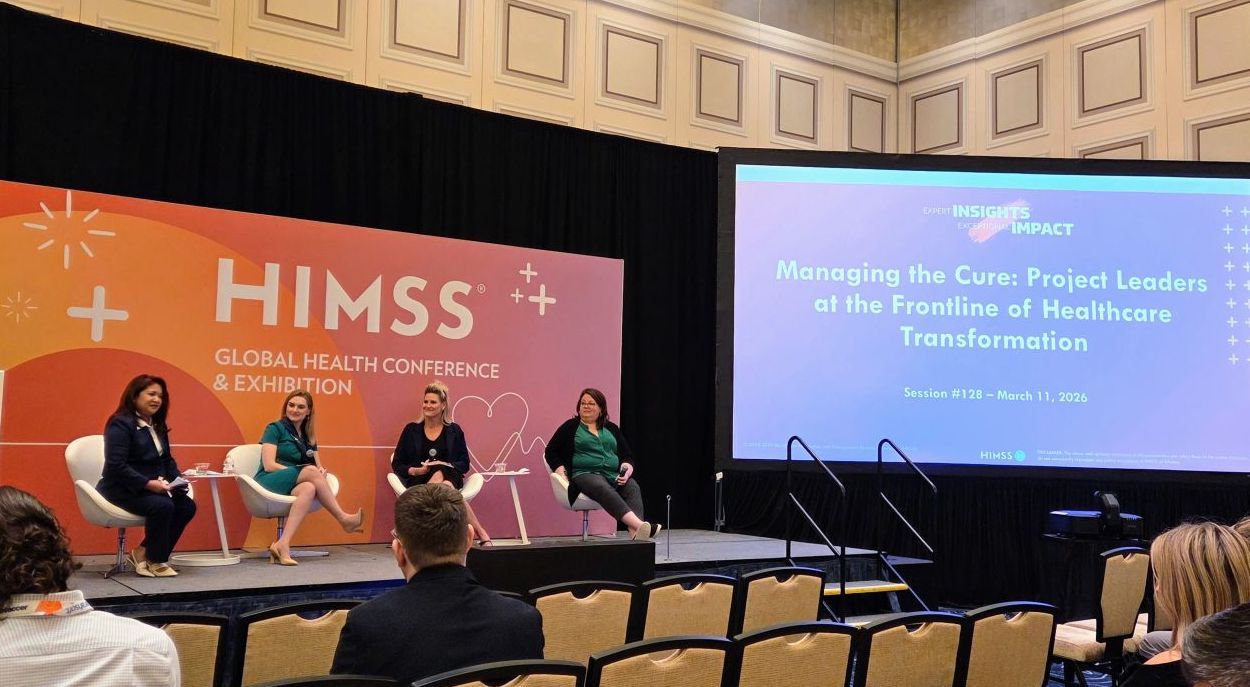
Summary:
What are the current hot topics in the healthcare landscape? After attending the HIMSS 2026 conference in Las Vegas, we saw a common theme:
– Healthcare value will not be defined by the sophistication of the technology itself, but by the maturity of the frameworks used to deploy it
– Automating your businesses busy work is becoming increasingly possible
– AI in healthcare needs to aid a patient-facing framework, not take over
In this article, we will go through each topic, highlighting the main points and how the healthcare industry is continually evolving in response to them. The HIMSS 2026 conference served as a critical reminder that, while healthcare technology is advancing at breakneck speed, the true challenge lies in operationalizing it.
Autonomous Revenue Cycle & Operational Governance
Speaker/Topic: Inova Health System | ED Coding & AI Automation
Inova shared its journey of implementing autonomous AI for Emergency Department (ED) coding across five hospitals. The focus was not just on the technology itself, but on the “deliberate implementation journey” and the governance framework required to maintain a 64% automation rate.
Their results?
- Efficiency Gains: Achieved a 64% automation rate and 66% FTE reallocation, leading to a steady, reliable operational rhythm.
- Governance First: Inova created an enterprise-wide governance framework before a formal AI department even existed, ensuring IT and clinical billing were aligned.
- Financial Integrity: High accuracy reinforced payer confidence and supported the achievement of HIMSS Stage 7 maturity.
What it means for Digital Transformation: Transformation is not a one-and-done project; it is an operational evolution. Success requires a structured framework that defines how the solution will be managed long after the contract is signed.
Marketing the “Human” Side of HealthTech
Speaker/Topic: Daymond John | Branding and Proof of Concept in Healthcare
Star of ABC’s Shark Tank, Daymond John, challenged the healthcare industry to move beyond “buzzwords” and focus on the emotional draw of technology. He emphasized that even the most brilliant doctors and engineers often struggle to market their solutions to the actual end-users.
His Emphasis?
- The “Three E” Rule: Focus on the emotional connection. Is the technology solving a true human problem for a child, a parent, or a patient?
- Proof of Concept: Move past the “big idea” and demonstrate a business model where the buyer and the user are aligned.
- Value Communication: Technical brilliance is useless if it isn’t “broadcast” in a way the world understands and wants to consume.
What it means for Digital Transformation: For transformation to take hold, the “internal marketing” is just as important as the tech. Stakeholders need to see the human value proposition to drive adoption. In order for a project to be successful, there needs to be passion and understanding to achieve real results.
Equitable Healthcare & Algorithmic Bias
Speaker/Topic: Chicago Booth & MIT | Mitigating Bias in AI
“When you serve communities who have been the recipients of historical racism and often medical racism, and for whom structural inequities are. Those patients are uniquely vulnerable to algorithmic bias.”
Speaker/Topic: Chicago Booth & MIT | Mitigating Bias in AI
Chicago Booth and MIT explored “post-processing” methods as a low-resource approach to mitigate algorithmic bias in healthcare, particularly in safety-net systems that may lack access to underlying training data.
Their findings?
- Post-Processing Utility: Changing model outputs (rather than retraining the whole model) is the cheapest and most accessible way to ensure fairness.
- Threshold Adjustments: Organizations can proactively adjust risk thresholds by 5-10 percentage points for different subgroups to optimize for equity.
- Cost-Effectiveness: Making AI “fairer” shouldn’t be cost-prohibitive for smaller health systems.
What it means for Digital Transformation: As AI becomes standard in clinical decision support, “Equity by Design” must be a functional requirement in your digital roadmap, not an afterthought.
Empowering Rural Healthcare Ecosystems
Speaker/Topic: Microsoft & Southern Coos Hospital | Rural Digital Access
A collective of leaders from Microsoft and rural health systems discussed the unique challenges of rural healthcare, focusing on cybersecurity and philanthropy.
Their Findings?
- Infrastructure Gaps: Rural systems face extreme resource constraints regarding income levels and access to care.
- Collaborative Philanthropy: Utilizing programs like Microsoft’s philanthropy arm can provide necessary cybersecurity and AI resources to smaller providers.
- Community-Centric Data: Recognizing that inherent system biases often stem from local socioeconomic data.
What it means for Digital Transformation: As mentioned previously, digital maturity must be inclusive. For payers and larger providers, supporting rural partners through shared digital resources is essential for population health management.
Reframing the Patient Experience
Speaker/Topic: Dr. Laura Cooley | Authentic Interaction
This session emphasized that “patient experience” should not be measured in a vacuum. It requires authentic interaction between vendors, executives, and families to reduce avoidable suffering.
Her Suggestions?
- Active Collaboration: Move away from taking actions in a vacuum and instead listen, learn, and respond to the patient’s actual voice.
- Defining the Customer: Recognition that “customers” include patients, families, and insurers—all of whom require a human-centric approach.
- Emotional Connectivity: Increasing human connection is the primary tool for reducing patient suffering.
What it means for Digital Transformation: Tools like patient portals or telehealth are only successful if they facilitate, rather than replace, human connection.
Project Leaders as the Frontline of Transformation
Speaker/Topic: Managing the Cure | PMO and Clinical Alignment
Focusing on the implementation of Virtual Nursing, this session highlighted why the Project Manager is the most critical link in healthcare transformation, serving as the bridge between executive vision and frontline reality.
Why work with a Project Manager in your healthcare implementation?
- The PM as Advocate: The PM ensures the “voice of the frontline staff” is maintained while simultaneously tracking milestones and KPIs.
- Safety Culture: Successful digital adoption is tied to a culture where employees feel safe saying, “I have a concern.”
- Consistency & Commitment: Transformation is a “long-term commitment,” often taking years (e.g., a 6-year journey to achieve an 80% reduction in safety events).
What it means for Digital Transformation: You cannot manage transformation solely through spreadsheets. It requires project leaders who understand clinical workflows and can manage the “pace of change” within the organization.
Conclude
Ultimately, the insights from HIMSS 2026 reinforce that the next era of healthcare value will not be defined by the sophistication of the technology itself, but by the maturity of the frameworks used to deploy it. For payers and providers, success requires moving beyond pilot programs and into a state of “operational excellence,” where AI is governed with rigor, project leaders act as clinical advocates, and digital tools are used to enhance, rather than replace, authentic human connection. By aligning technical roadmaps with structured execution, organizations can finally turn the promise of digital transformation into sustainable enterprise value.
At Tuck Consulting Group, we believe that digital transformation is only as good as its execution. Whether you are automating your revenue cycle or launching a virtual care pilot, the common thread is structured consistency.
Is your organization ready to operationalize its next big project? Contact us today to see how our agile approach can accelerate your healthcare initiatives.